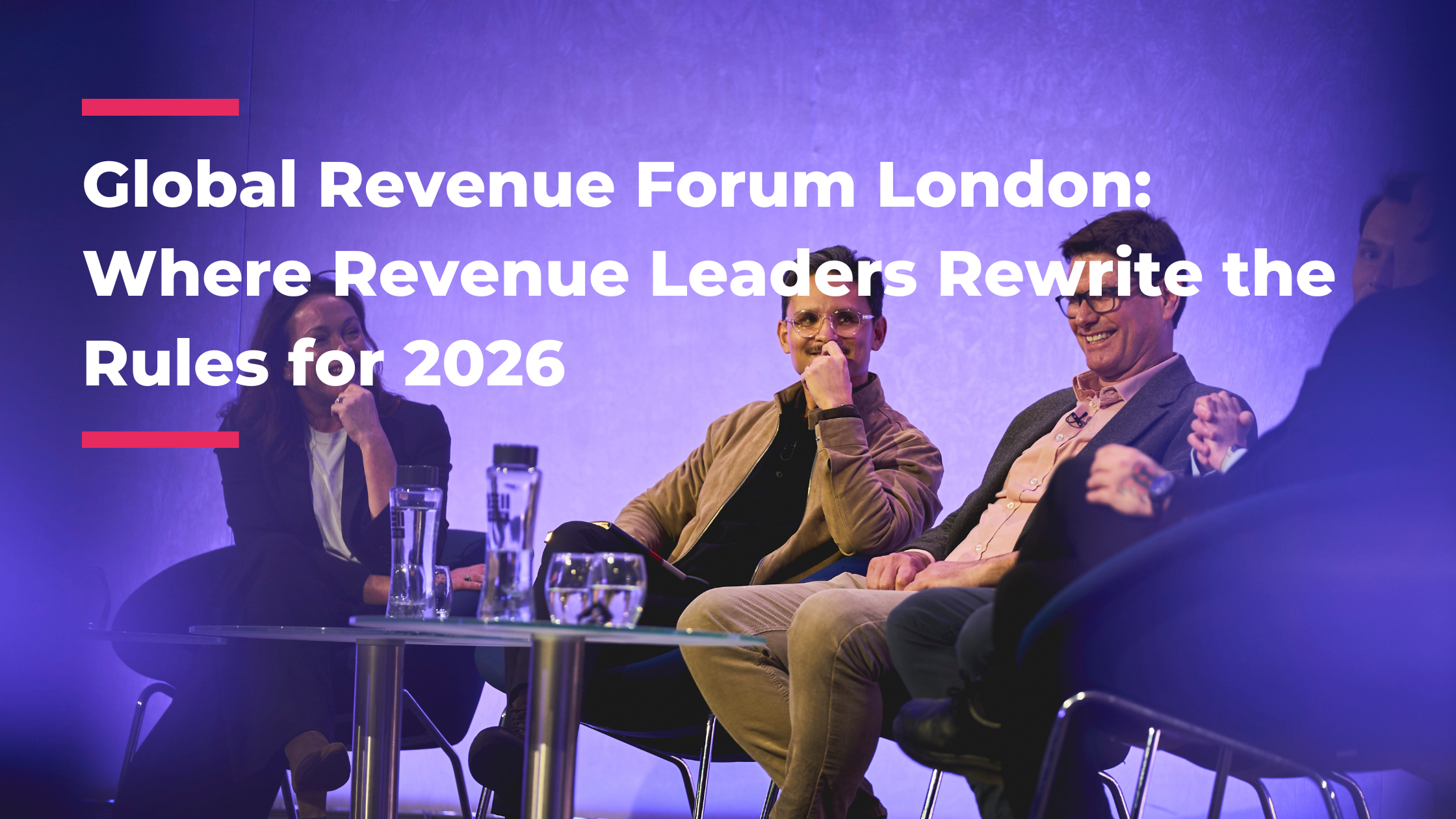
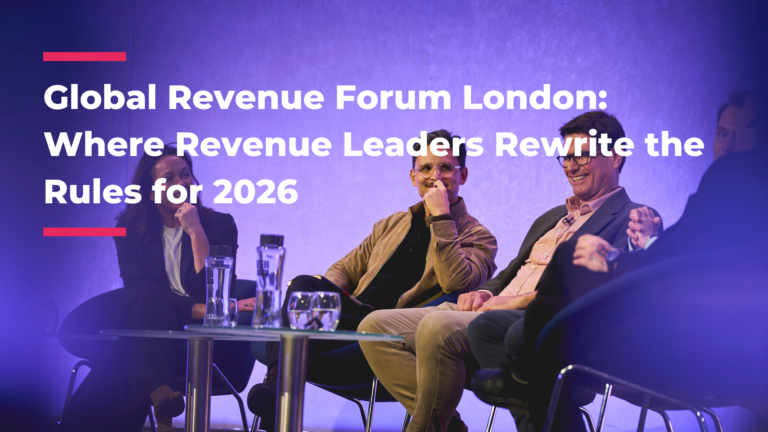
Every January, a remarkable thing happens in London: a community of hotel revenue and commercial leaders comes together to pause, reflect, and reset for the year ahead.
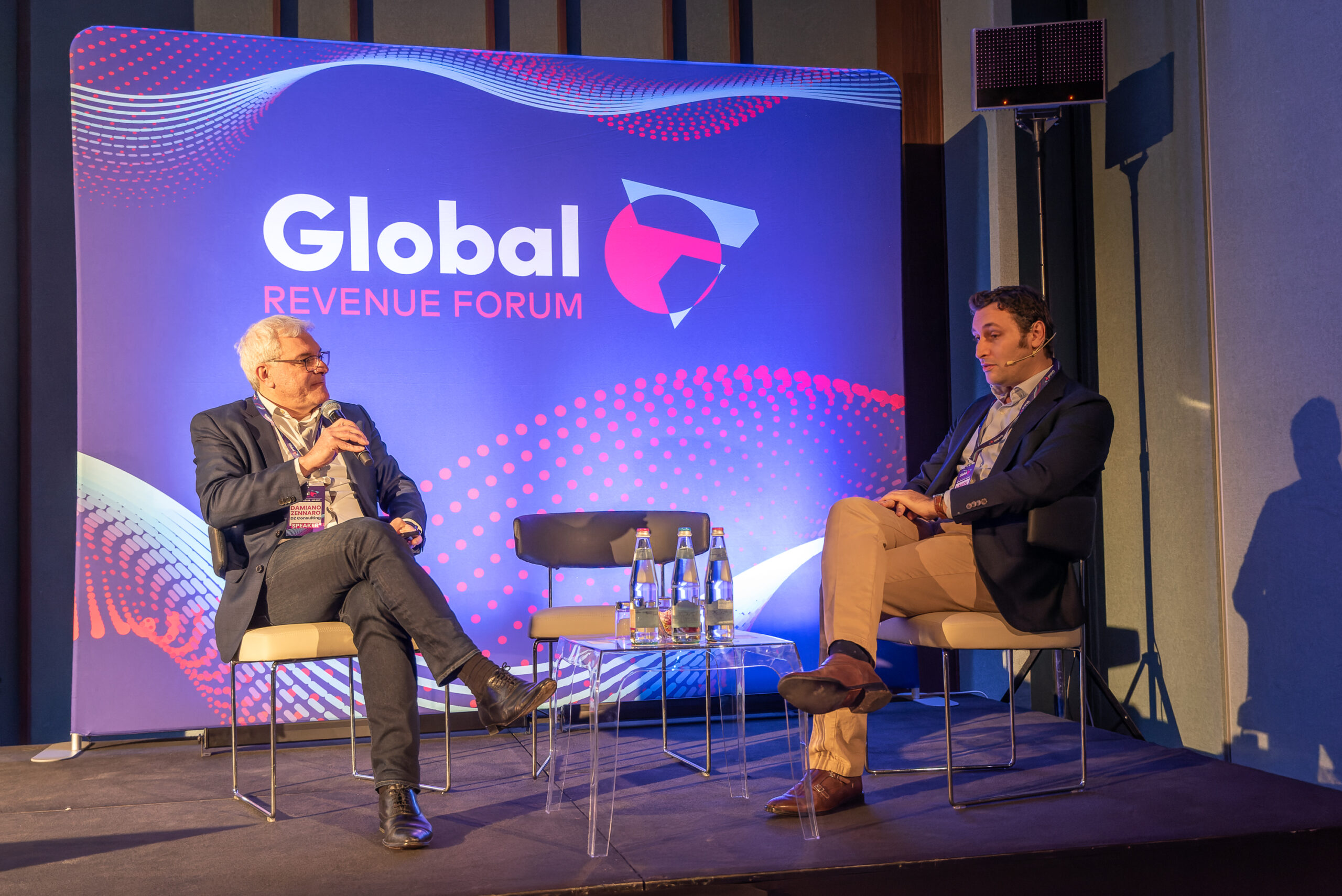
The Global Revenue Forum, London 2026 is the industry event that everyone wants to be at. Stepping into the forum at the QEII Centre, you could sense a buzz of energy, the kind that comes when people arrive ready to challenge ideas and share insights.
By the end of the day, one thing was clear, this wasn’t business as usual. GRF London has become a place where revenue leaders actively rewrite the rules of their game, together, in real time.
A community converges, with a global twist
From the first welcome coffee, the atmosphere was buzzing with excitement. Many attendees greeted each other like old friends, because in many cases, they were. The forum has built a loyal following, and this year there was an added moment of meaning, a celebration marking Revenue by Design’s 20 year milestone, recognising the work and leadership that has helped shape the revenue community over time. It was a reminder that while the industry moves quickly, the relationships and contributions that underpin it are built over years.
Notably, “Global” isn’t just a buzzword in the event title, it’s a literal description. As London’s attendees settled in, they were joined virtually by peers in Stockholm and Milan, all participating simultaneously.
Throughout the day, keynote speeches delivered in Milan and Stockholm were streamed to the London audience too, and the format created one cohesive conversation spanning Europe.
Revenue leaders across each location explored the same core theme, with every speaker adding a distinctly local lens. Milan keynote speaker, Cindy Heo, shared that following her session she received messages from an extraordinary mix of people including those who attended in person in Milan, those who watched the keynote streamed live in London and Stockholm, others who joined virtually, and even some who heard about the session second-hand through colleagues. The Global Revenue forum truly does feel global.
What ties those cities together is a shared focus. Every location followed the same theme, Commercial Leadership for the Next Generation, and the message was consistent throughout the day. While technology and AI featured in the discussion, the emphasis was clear, progress in hospitality right now depends on people first. Leadership, judgement, and human connection are proving far more decisive than any tool alone.
In an industry that’s truly global, that felt incredibly valuable.
Human stories: multi generational teams and the human skills renaissance
The day opened with a clear signal that this was not going to be a tactical, tool-led agenda. The opening keynote set the tone by focusing on leadership, not mechanics, and people responded to that immediately.
Henry Rose Lee’s keynote on intergenerational leadership became one of the most referenced moments of the day, not because it was provocative, but because it felt uncomfortably familiar.
She brought a sharp, practical lens to what many teams are feeling, the real challenge of leading across generations, without slipping into stereotypes, silos, or assumptions about who adapts fastest. Her session landed because it gave language, context, and a clear call to action for leaders managing change in mixed experience teams.
As Eloise Hanson reflected afterwards,
“A brilliant keynote from Henry Rose Lee… shared goals, objectives and vision are a far stronger uniting force than generational labels.”
That theme carried into a panel discussion on designing multi generational commercial teams, where the focus quickly moved away from theory and into lived experience. How silos form unintentionally, how technology can divide as easily as it can enable and how alignment around outcomes matters more than who adopts fastest.
The attention given to so called soft skills, often reframed as human skills, felt timely.
In the age of AI and automation, the human element is no longer a nice to have, it is central. What stood out across the day was how openly this was acknowledged, particularly in a forum historically associated with numbers, systems, and optimisation.
Several attendees commented on how refreshing it felt to see people, leadership, and communication given real weight alongside technology. Reflecting on the day, Olga Sommer captured this shift clearly when she wrote that the forum offered “wonderful insights on human skills (note not soft skills)”, highlighting that commercial performance is increasingly shaped by how well leaders understand and support the people behind the data.
That sentiment underlined a broader realisation from the day, revenue leadership is no longer just about understanding performance, but about understanding people, and how teams navigate change together.
Big themes: AI with accountability, and total revenue beyond rooms
If one theme dominated the day, it was Artificial Intelligence, but approached in a refreshingly grounded way. Yes, AI was the star of many sessions, yet the discussions had matured far beyond last year’s “wow” factor. The consensus this year, AI is here to stay, now how do we make it actually work for us. Across panels and presentations, there was a clear emphasis on practicality, use cases, integration, and measurable value, not just experimentation.
Another clear thread running through the day was the continued move away from thinking about revenue purely through the lens of the hotel room. This wasn’t presented as a new idea, but as something many leaders are already grappling with in practice.
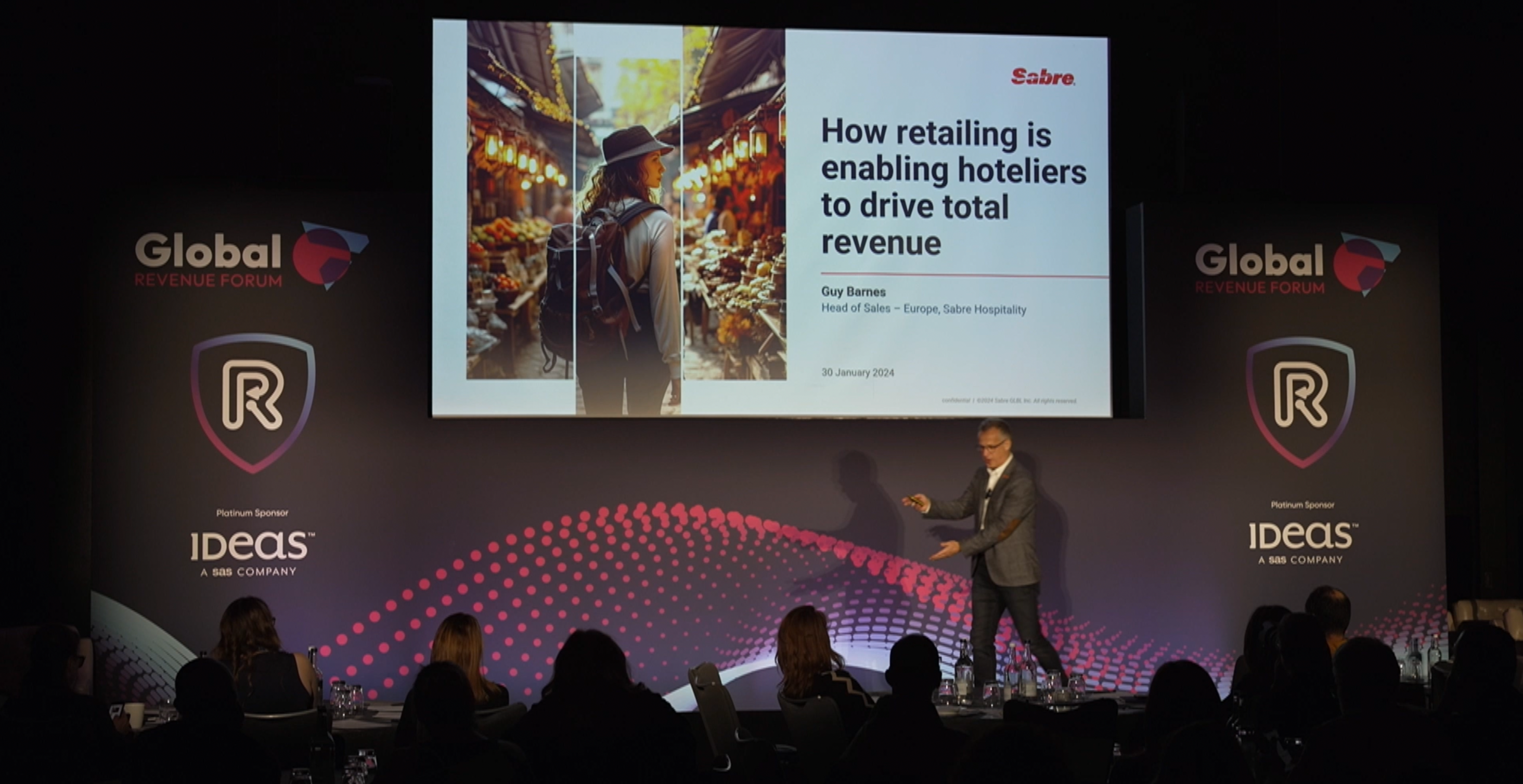
During his session, Florian Montag summed it up simply and memorably when he said that “revenue is more than heads in beds”. It landed because it reflected reality. Heads nodded across the room, not because it sounded clever, but because it described where many businesses already are, or need to be.
Across sessions and conversations, people talked openly about the growing importance of ancillary revenue and total revenue management. Restaurants, spas, meetings and events, co working spaces, upsell programmes, even subscription style models all featured as examples of how hotels are broadening their commercial focus. Several case studies shared on stage showed that when teams stop optimising individual departments in isolation and start looking at total guest spend, performance follows.
What was particularly striking was how often this conversation returned to mindset rather than mechanics. The agenda explored ways of tapping into local demand, rethinking how hotel spaces are used, and packaging experiences rather than simply selling nights. It felt less like a checklist of tactics and more like a reframing of the revenue role itself.
The shift is subtle but significant. Revenue managers are increasingly being asked to think and act as commercial strategists, people who understand the full ecosystem of the property, and who can spot opportunity wherever value is created, not just where rooms are sold.
Optimism, energy, and realism, all at once
The commercial outlook at GRF London 2026 felt mature. There was confidence in the direction of travel, genuine curiosity about new approaches, and a shared understanding that progress now depends on better judgement, not just more activity.
As conversations turned to machine learning, pricing, and the modernisation of commercial processes, there was a noticeable shift in how people were engaging with the topic. The questions felt more considered and more practical than in previous years. Discussions focused on what good implementation actually looks like, how impact can be measured, and how teams are brought along rather than left behind.
That tone carried through the day. There was plenty of enthusiasm, but it was grounded, shaped by experience and a shared desire to find solutions that work in the real world. One word that came up more than once in conversations was energised. Delegates spoke about leaving with momentum rather than fatigue, and much of that came down to the structure of the day. The mix of formats, alongside time built in for reflection and discussion, gave people space to think.
Several attendees commented that some of the most valuable moments didn’t happen on stage at all, but in the conversations between sessions. Reflecting on the scale and energy of the day, Alexandra Fjällman noted the impact of bringing Stockholm, London, and Milan together, creating space for ideas to travel well beyond individual sessions.
Meaningful conversations trump hype
The intention behind Global Revenue Forum London, shaped and delivered by Revenue by Design, has always been to create space for proper industry conversation, and this year it really showed. The day didn’t feel like a sequence of talks you sit through, or a series of sales messages you tune out. It felt shared.
It never felt like speakers were talking ‘at’ the room, they were in it and that seemed to make a real difference. People asked questions they actually cared about, challenged points they didn’t agree with, and connected the discussion back to what they’re dealing with day to day.
Because of that, the day felt insightful rather than overwhelming. Conversations carried on as everyone left the room, with ideas people wanted to try, discussions they planned to pick up again, and questions that felt worth spending more time on. By the end of the day there was a quiet sense of clarity, a better understanding of what deserves focus next, even if not every answer was fully formed yet.
Looking ahead: the momentum continues
If the conversations at GRF London are any indication, the hospitality revenue community is charging into 2026 with confidence, curiosity, and a collaborative spirit. Challenges were acknowledged, fast moving technology, talent pressures, changing guest behaviour, but the mindset was solution oriented. People left with actionable ideas, and a network of peers to keep learning with.
And perhaps that’s the point. GRF London isn’t just about what is said on stage, it’s about the shared thinking it unlocks across the room, and the way that thinking continues, long after the venue empties.
If you want to be among the first to know about GRF2027, then register your email here: GRF2027